
The one-month stay at the Egyptian Department of the Fine Arts Museum in Budapest had the purpose of examining directly a lot of 30 Ptolemaic wooden coffins that are included in my PhD dissertation, titled “Wooden anthropoid coffins of the end of the Pharaonic and Greek Periods (6th–1st century BC): technical features, typology and chronology”.
This lot of coffins is particularly important in my study because it forms a coherent group, since they all come from the same site in Egypt (Gamhud). This is a very useful aspect, in that it allows the identification of a specific regional style of coffin manufacture and decoration, as well as of its chronological evolution from the end of the Late Period until the end of the Ptolemaic Period (525–30 BC).
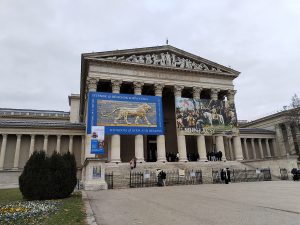
The imposing façade of the Fine Arts Museum in Budapest
The activities I had planned for my short stay included, on the one hand, mostly the observation and study of all the 30 coffins from Gamhud, including taking photographs, carefully measuring the coffins, reading and copying the hieroglyphic inscriptions, and verifying that such data as, for example, the inventory numbers provided in printed catalogues were all correct. On the other hand, the information I would gather would have to be entered in my personal coffin database, in order to make it comparable to the other coffins included in my research.
The staff at the Museum has been extremely welcoming: not only they managed to make me feel at home in an institution I had never visited before, but they were also extremely helpful in providing study material so that my job there would be easier. On a personal level, the visit has given me the chance of creating strong personal bonds with the people at the Museum, forming the basis for a solid friendship and for future collaborations.
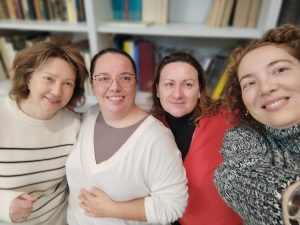
The start of a great friendship: (from the left) Dr. Katalin Kóthay, head of the Egyptian Department at the Museum, myself, Mrs Flóra Kevély, and Dr. Gabriella Dembitz, two of the Curators of the Egyptian collection
Among the many facilitations I have received, I was granted access to the storage rooms, where most of the coffins are presently kept. This meant that I could examine the coffins without a glass in front of them; I could go as close as I wanted and that – apart from being a huge advantage in my job, for it allowed me to see details that otherwise would be lost, like the sealing mechanisms of the coffins – was also something that made me very emotional: it was an honour to be trusted so much by the Hungarian colleagues. Though, I have to admit that measuring the coffins, some of which being more that 2 m tall, has proven quite the challenge, even with the help of Dr. Kóthay.
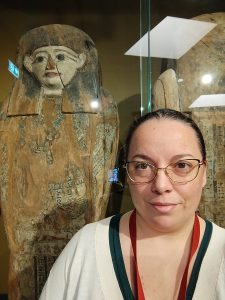
The lady and the coffin: me standing in front of the display case of the Gamhud coffins at the Museum*
In addition to all that, the Department library was put at my disposal and I have been also able to meet and discuss the coffins with Dr. Éva Galambos, the conservator who has analyzed and restored most of the coffins, and who is now working on the fragments. She was so kind to share with me information about the type of wood used for making the coffins and about the different pigments used in their decoration. These are extra data that complete the picture I am trying to form on coffin manufacture of the end of the Late Period and the Ptolemaic one.
Furthermore, I have been provided with copies of the existing photographic documentation of the coffins, so that I was able to save a considerable amount of time. This allowed me not only to complete the activities I had planned, but to do more. The many useful discussions with Dr. Kóthay about ancient Egyptian funerary workshops and how the different objects included in funerary assemblages were manufactured have led me to have a clearer idea of what to look for in my research, while the study of many archaeological reports which I could not find in other libraries I had access to so far provided the basis for a significant rearrangement of my catalogue of coffins, so that now it is better suited to account for the differences in the available data on the objects I am working with.
To sum up, my stay at the Fine Arts Museum in Budapest has been very successful experience from a professional point of view, but also one that deeply enriched me as a person.
Susanna Ruo Redda Moser
Budapest, 24 December 2024
∗ As most of the coffins are in storage, I was not allowed to use the photographs I have taken there for copyright reasons. Therefore, this is the only picture that can be publicly used.
